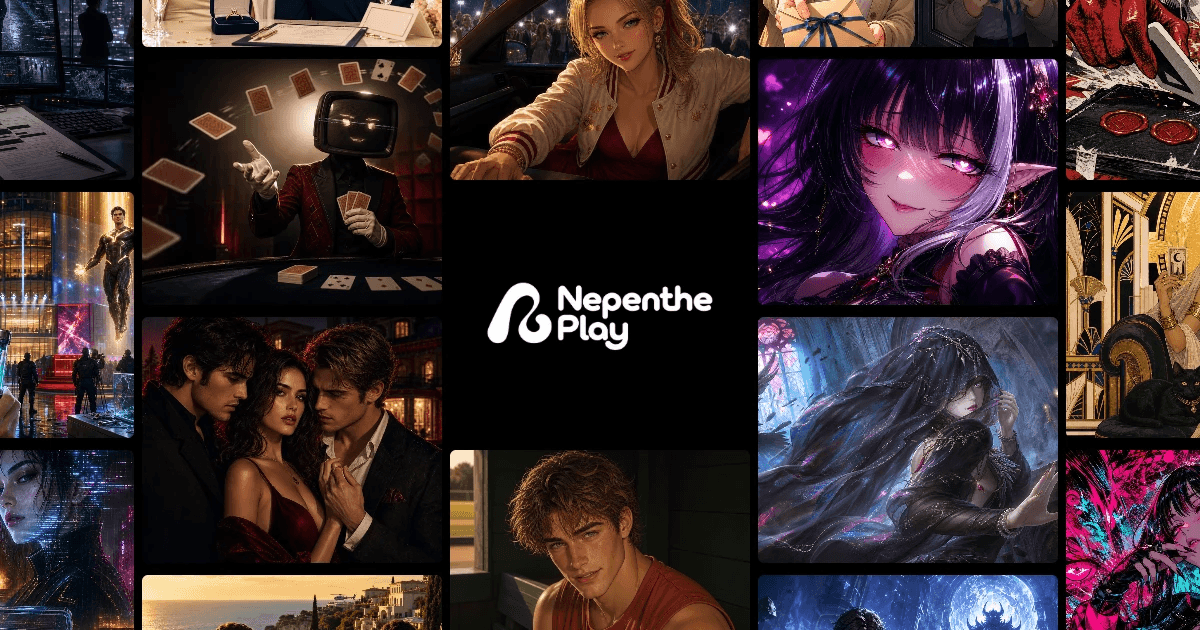
Nepenthe Play is a browser-based platform for AI-native games. We’re starting with games, characters and interactive stories you can play, and building toward a place where you can make your own.
Behind it is a question we keep coming back to: if AI changes how much time we spend working, what will we want to do with the time it gives us?
We hope some of it goes toward play. Getting friends together. Following a strange idea. Finding something so funny, surprising or absorbing that nobody is checking the time.
That future is not inevitable. But it is one we want to help build.
AI as part of the game
A good human game host can understand a question nobody anticipated. They can follow an unusual line of reasoning, notice that someone is bluffing, or keep a story moving when the players take it somewhere unexpected.
We’re interested in what happens when AI can take on some of those roles.
By AI-native games, we mean games where AI participates in the play itself: interpreting what you do and responding within the game’s rules. Your choice of words, approach or strategy can become something the game understands.
Our starting point is familiar kinds of play where that flexibility has a clear purpose. In Riddle Royale, an AI host holds the answer to a mystery while you work toward it through questions. In Gotcha Liar, AI opponents sit across the card table and bluff. Characters and interactive stories explore other possibilities, from an unfolding relationship to a scene you can help direct.
These are starting points. More capable models, lower costs and better ways of maintaining context should let us attempt more over time. The test is whether those advances make a game more enjoyable to play.
Play it
 StrategyRiddle RoyalePlayYou've read the lists. Hard riddles with the answers printed underneath, and scrolling down never felt like solving anything. This one has a host. You get a death that makes no sense, and you can ask him anything until you crack it. He only says yes, no, or irrelevant. New case every time.
The idea still belongs to someone
Making a game has traditionally required skills, time and resources that put it out of reach for many people. AI is changing parts of that process. But making something run and making something fun are different problems.
A joke that works with your friends might mean nothing to anyone else. A familiar game can become the best part of an evening because somebody changes one rule at exactly the right moment.
That kind of judgment matters to us: knowing the people you are making something for, understanding what they find funny, and caring enough to try again when an idea falls flat.
We want people with that instinct to be able to make games, whether or not they know how to code.
A game for the people in the room
Here is a future we would love to make possible.
You’re at a party. Someone says, “What if we played a game where…?” A few people add ideas. You take out your phone, describe the premise, shape the rules, and share something everyone can start playing while the idea is still fresh.
AI could help turn that premise into a playable game and host it, adapting to the situation as people play. The people in the room would bring the reason it is worth playing.
That is a long-term ambition, not a feature we are announcing today. Our path starts with making games ourselves, learning from players, and opening up creation so that other people can take it in directions we would never have thought of.
Why Nepenthe?
Nepenthe takes its name from Homer’s Odyssey, a word associated with forgetfulness of sorrow. We chose it for the kind of place we want to build: somewhere to put the day’s worries aside, get caught up in a game or a story, and enjoy being there.
You can explore Nepenthe Play at nepentheplay.com. It runs in your browser, with no download required.
Come play something. We hope it gives you an idea.
Play what you just read about
StrategyRiddle RoyalePlayYou've read the lists. Hard riddles with the answers printed underneath, and scrolling down never felt like solving anything. This one has a host. You get a death that makes no sense, and you can ask him anything until you crack it. He only says yes, no, or irrelevant. New case every time.